
E-Challan Check
Have you received an SMS about a traffic violation but don’t know how much you owe? Punjab’s e-challan system now tracks every traffic rule break through Safe City cameras across major cities.
The PSCA (Punjab Safe Cities Authority) automatically records violations like signal jumping, wrong parking, No helmet and over speeding. Drivers must check their e-challan status regularly to avoid vehicle registration blocks and increased fines under the new December 2025 enforcement rules.
E Challan Check Online lets Punjab drivers view traffic violations instantly through the PSCA portal. Enter your vehicle registration and CNIC to see all pending fines from Lahore, Rawalpindi, Faisalabad, Multan, Gujranwala, and Sialkot. Pay directly via JazzCash, Easypaisa, or bank apps to clear records and maintain clean driving history.
What Did Chief Minister Announce on December 2, 2025? Latest Update
Chief Minister Maryam Nawaz announced two major changes on December 2, 2025. Punjab now allows 16-year-olds to obtain motorcycle driving licenses with parental consent and proper training. Additionally, first-time helmet violations receive warning challans instead of Rs. 2,000 fines. Second violations trigger full penalties. These changes balance safety enforcement with practical needs across Punjab.
Table of Contents
What Is E-Challan System in Punjab?
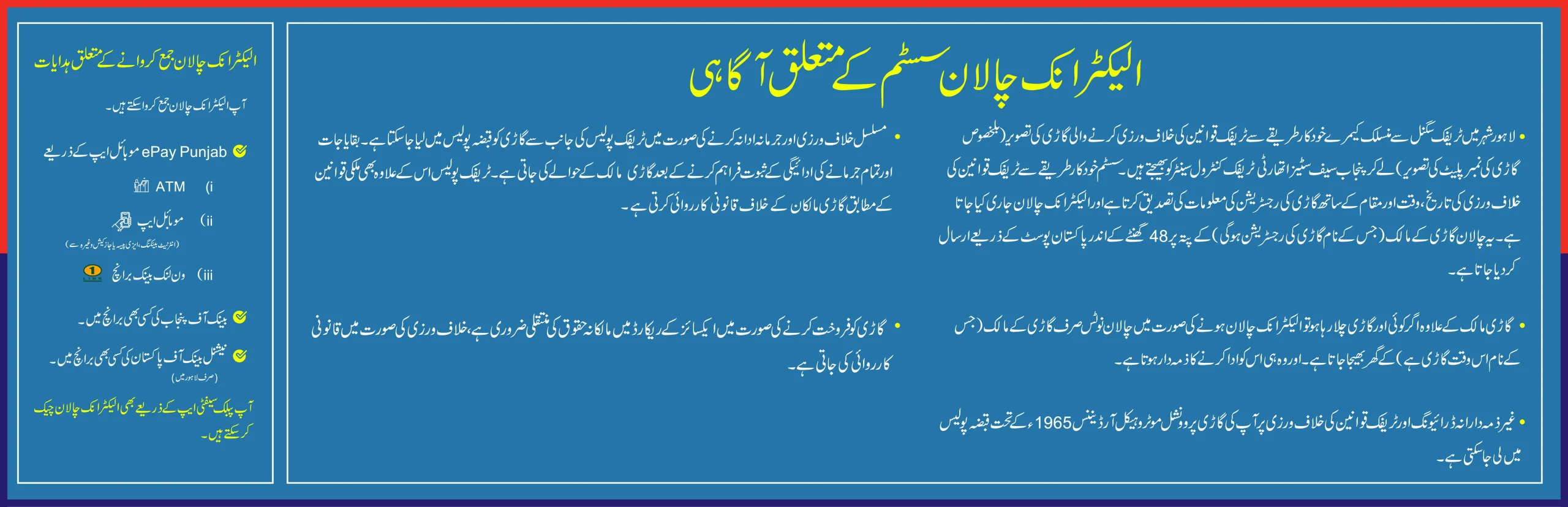
E-challan means electronic challan. Punjab uses this digital system to issue traffic fines without paper tickets. When Safe City cameras catch a violation, the system sends an automatic challan to the vehicle owner’s registered mobile number.
The Punjab Safe Cities Authority manages this system. It covers cities like Lahore, Rawalpindi, Faisalabad, Multan, Gujranwala, Bahawalpur, Sargodha and even small Tehsils like Taunsa . Each violation gets recorded with photo evidence, time stamp, and location details.
Drivers can view their pending fines online anytime. The system links violations to your CNIC (Computerized National Identity Card) and vehicle registration number. This creates a permanent digital record in the DLIMS (Driving License Issuance Management System) database.
How Punjab E-Challan System Works?
Safe City cameras watch major roads, intersections, and traffic signals 24 hours daily. When a vehicle breaks traffic rules, cameras capture the violation automatically. The system reads the number plate using advanced technology.
Within minutes, the database matches the vehicle number with owner details. An SMS notification goes to the registered mobile number. The message includes the violation type, location, date, and fine amount.
All data stores in the central PSCA database. Vehicle owners must check their challan status on the official portal using their vehicle number and CNIC. Payment options include mobile wallets, bank apps, and ATMs.
The December 2025 update increased fines significantly. Most violations now cost Rs. 2,000 for first-time offenders. Repeat violations carry penalties up to Rs. 15,000 with possible imprisonment for serious cases.
Why E-Challan Check Matters Now?
Chief Minister Punjab Maryam Nawaz enforced stricter traffic laws from December 1, 2025. The new system aims to reduce road accidents and improve driving discipline across Punjab province.
Every violation now creates a permanent record in your DLIMS profile. This affects multiple areas of vehicle ownership and driving privileges.
License Renewal Issues:
Multiple unpaid challans can delay or block your driving license renewal application. The system checks your violation history before approving renewals.
Token Tax Problems:
Excise and Taxation offices verify challan clearance before issuing new vehicle tokens. Unpaid fines prevent annual registration renewal.
Insurance Complications:
Some insurance companies check driving records during policy renewal. A history of violations may affect premium rates or coverage approval.
Checkpoint Stops:
Traffic police access the e-challan database at checkpoints. Officers can see all pending fines instantly and may take action on the spot.
Vehicle Impoundment Risk:
Accumulated fines exceeding vehicle value can lead to impoundment or auction under Punjab traffic laws.
The digital system makes hiding violations impossible. Every traffic rule break stays in your record until paid and cleared properly.
How to Check E Challan Online? Step by Step Process for Citizens of Punjab
Checking your Punjab e-challan takes only minutes. Follow these exact steps for accurate results.
Step 1: Visit Official Portal
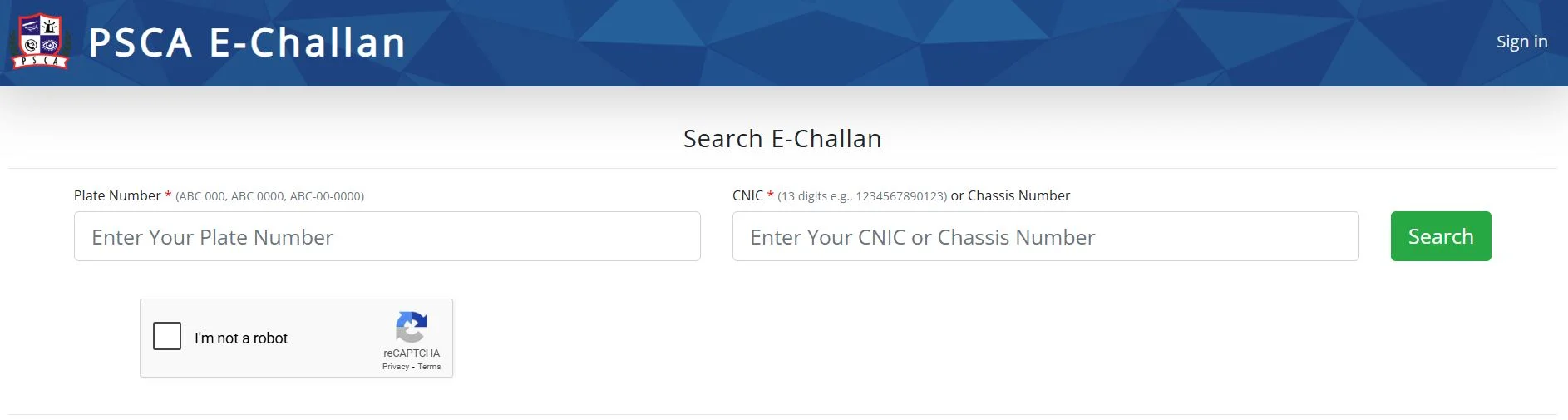
Open your browser and go to https://echallan.psca.gop.pk/. This is the only authentic PSCA website for challan verification. Avoid fake websites that may steal personal information.
Step 2: Enter Vehicle Registration Number
Type your complete vehicle number in the first field. Include all letters and numbers exactly as shown on your number plate. Common formats include LEA-19-1234, RIU-456, or FSD-20-7890.
Step 3: Provide CNIC Number or Chassis Number
Enter your 13-digit CNIC without dashes or spaces or just enter your Chassis Number. The system uses this to verify vehicle ownership and match records correctly.
Step 4: Complete Security Check
Click the “I’m not a robot” verification box. This prevents automated system abuse and ensures real user access.
Step 5: Click Search Button
Press the green Search button. The system processes your request and displays results within seconds.
Step 6: Review Results
Your screen shows all pending and paid challans. Each entry includes violation type, date, time, location, fine amount, and payment status. Photo evidence appears for camera-based violations.
Check your e-challan status at least once monthly. This prevents accumulation of fines and helps maintain a clean driving record.
Understanding Your E-Challan Details
Each challan entry contains specific information that drivers must understand clearly.
Challan Number:
A unique identification code for each violation. Use this number for payment processing and record tracking.
Violation Type:
Describes the exact traffic rule broken. Common types include signal violation, wrong parking, lane violation, overspeeding, no helmet, and mobile phone usage while driving.
Date and Time:
Shows exact moment when the violation occurred. This helps verify if you were actually driving at that time.
Location Details:
Specifies the exact camera location or checkpoint where the violation was recorded. GPS coordinates may appear for precise identification.
Fine Amount:
Shows the penalty you must pay. First-time violations typically cost Rs. 2,000. Repeat offenses increase to Rs. 5,000 or Rs. 15,000 depending on severity.
Photographic Evidence:
Camera captures show your vehicle committing the violation. Images include clear number plate visibility and violation context.
Payment Status:
Indicates whether the challan is pending, paid, or under review. Paid challans show payment date and transaction reference number.
PSID (Payment Slip ID):
A special code used for payment through banks, ATMs, and mobile apps. Save this number for transaction processing. Review each detail carefully. If you notice errors or believe the challan was issued incorrectly, contact PSCA helpline immediately for clarification
How Can You Pay Your E-Challan in Punjab Online?
Punjab offers multiple convenient payment channels. Choose the method that works best for your situation.
JazzCash Mobile Wallet:
Open the JazzCash app on your phone. Select “Bill Payments” from the main menu. Find “E-Challan” or “Traffic Challan” option. Enter your vehicle number and CNIC. The app displays all pending fines. Select challans to pay and confirm the transaction. You receive instant payment confirmation via SMS.
EasyPaisa Mobile Wallet:
Launch the EasyPaisa app. Navigate to “Government Payments” section. Choose “Traffic Fine” or “E-Challan” option. Input your vehicle registration number. Verify challan details and complete payment. Keep the transaction ID for your records.
Bank Mobile Apps:
Most Pakistani banks support e-challan payments through their mobile banking apps. Login to your bank app. Find “Government Payments” or “Challan Payment” section. Enter the PSID from your e-challan. Confirm payment details and authorize the transaction.
1-Link ATMs:
Visit any 1-Link enabled ATM across Pakistan. Insert your ATM card and enter PIN. Select “Bill Payment” or “Challan Payment” option. Choose “Traffic Challan” category. Enter your PSID number carefully. Verify amount and complete transaction. Keep the printed receipt as proof.
National Bank of Pakistan Branches:
Visit any NBP branch with your PSID and CNIC. Fill the challan payment form at the counter. Submit it with cash or through your NBP account. Bank staff process payment and provide a stamped receipt. This receipt serves as official payment proof.
Online Banking Portals:
Access your bank’s internet banking website. Login with credentials. Navigate to bill payments section. Search for PSCA or traffic challan option. Enter required details and process payment online.
Always save payment confirmation receipts. These prove you cleared the fine if system updates face delays. Payment typically reflects in the PSCA database within 24 to 48 hours.
How to Reprint Your E-Challan?
Lost your original challan notification? The reprint feature solves this problem quickly.
Visit the official PSCA portal at https://echallan.psca.gop.pk/. Enter your vehicle number and CNIC as usual. Click the Search button to display all your challans. Find the specific challan you need to reprint. Click the “Print” or “Download” button next to that entry.
The system generates a PDF document containing complete challan details. This includes violation information, photo evidence, fine amount, and PSID. Save this PDF to your device or print it immediately.
Use the reprinted challan for making payments at banks or for reference during appeals. The reprinted version carries the same legal validity as the original SMS notification.
Keep digital and physical copies of all traffic-related documents. This helps during vehicle verification processes and prevents disputes.
What are the Common Traffic Violations in Punjab?
Understanding frequent violations helps drivers avoid unnecessary fines.
Signal Jumping:
Running red lights accounts for thousands of challans monthly. Safe City cameras capture vehicles crossing stop lines after signal turns red. Fine: Rs. 2,000 first offense, Rs. 5,000 to Rs. 15,000 for repeat violations.
Wrong Parking:
Parking in no-parking zones, near fire hydrants, or blocking traffic flow triggers automatic challans. Fine: Rs. 2,000 initially, increases with repetition.
Lane Violations:
Crossing solid white lines, using emergency lanes without permission, or improper lane changing gets recorded. Fine: Rs. 2,000 first time, up to Rs. 15,000 for repeaters.
Overspeeding:
Speed cameras detect vehicles exceeding posted limits. Fines vary based on how much you exceed the limit. Serious overspeeding can result in Rs. 20,000 penalties.
No Helmet (Motorcycles):
Riding without proper helmet protection is extremely common. Cameras identify unhelmeted riders easily. Fine: Rs. 2,000, repeat offense Rs. 5,000.
Mobile Phone Usage:
Using phone while driving without hands-free device creates safety hazards. Cameras and traffic wardens issue challans for this violation. Fine: Rs. 2,000.
Zebra Crossing Violations:
Not stopping for pedestrians at marked crossings shows disregard for safety. Fine: Rs. 2,000 increasing with repetition.
Modified Number Plates:
Fancy fonts, wrong sizes, or stylized plates prevent camera recognition. Fine: Rs. 2,000, vehicle may be impounded until proper plate installed.
Carrying Excess Passengers:
Overloading vehicles beyond legal capacity endangers lives. Fine: Rs. 3,000 first offense, Rs. 15,000 for repeat violations, possible 6-month imprisonment.
Driving Without License:
Operating vehicles without valid driving license is serious. Fine: Rs. 2,000 initially, Rs. 15,000 for repetition, up to 6 months imprisonment possible. Each violation receives documentation in your permanent DLIMS record.
Multiple violations within short periods trigger closer monitoring and stricter enforcement actions.
Where Are the Safe City Camera Locations?
PSCA operates extensive camera networks in major Punjab cities.
Lahore:
Over 8,000 cameras cover main roads, signal points, and major intersections throughout the city. Mall Road, Ferozepur Road, Jail Road, Canal Road, and Ring Road have dense camera coverage. Challans from Lahore appear as “online challan check Lahore” in search results.
Rawalpindi:
Integrated with Islamabad Safe City, Rawalpindi has cameras on Murree Road, Sixth Road, Mall Road, and all major entry/exit points. The twin cities share violation data for comprehensive monitoring.
Faisalabad:
Industrial city cameras focus on Canal Road, Jail Road, Sargodha Road, and major commercial areas. Factory zones receive special attention during peak hours.
Multan:
Strategic camera placement covers main boulevards, signal points near hospitals and schools, and highway entry points. The system expanded significantly in 2024.
Gujranwala:
As a major industrial hub, Gujranwala’s cameras monitor GT Road sections, main city roads, and commercial districts. Focus areas include GT Road, Model Town, and Civil Lines.
Bahawalpur:
Recently added to Safe City network, Bahawalpur covers main city roads and connections to national highways. System expansion continues.
Sargodha:
Camera network covers main city intersections, university road, and connections to M2 motorway. Active enforcement started in late 2024.
More cities join the Safe City project regularly. Soon, most Punjab districts will have automated traffic monitoring systems.
New Traffic Fine Structure December 2025
The Punjab government implemented major fine increases effective December 1, 2025. This represents the most significant traffic law reform in recent years.
Section 89A – Number Plate Display:
Vehicles must display approved number plates clearly. Fine: Rs. 2,000 first offense, Rs. 5,000 repeat violation.
Section 89B – Child Seatbelt:
Children sitting in front seats must wear seatbelts. Fine: Rs. 2,000, repeat Rs. 5,000.
Section 97 – Driving Without License:
Operating vehicles without valid driving license carries serious penalties. Fine: Rs. 2,000 initially, Rs. 15,000 for repeat offenses, possible 6-month imprisonment.
Section 98A – General Traffic Rule Violations:
Breaking any traffic regulation falls under this broad category. Fine: Rs. 2,000 first time, Rs. 15,000 repeat, up to 6 months imprisonment possible.
Section 99B – Underage or Careless Driving:
Allowing minors to drive or demonstrating reckless behavior. Fine: Rs. 2,000, repeat Rs. 15,000, imprisonment up to 6 months.
Section 105A – Dangerous Vehicle Condition:
Using or selling vehicles with safety defects. Fine: Rs. 2,000, repeat Rs. 15,000, possible 2-year imprisonment for serious cases.
Section 106A – No Fitness Certificate:
Commercial vehicles must maintain valid fitness certificates. Fine: Rs. 2,000, repeat Rs. 15,000, 6-month imprisonment possible.
Section 106B – Excess Passengers:
Carrying more people than vehicle capacity allows. Fine: Rs. 3,000 first offense, Rs. 15,000 repeat, 6-month imprisonment possible.
Section 112A – Emergency Lane Misuse:
Using emergency lanes without valid reason blocks rescue vehicles. Fine: Rs. 2,000, repeat Rs. 15,000, 6-month imprisonment possible.
Section 112D – Modified Lights:
Installing non-standard or excessively bright lights. Fine: Rs. 2,000, repeat Rs. 15,000, 6-month imprisonment possible.
Section 112E – Illegal Window Tints:
Using black or heavily tinted windows beyond legal limits. Fine: Rs. 2,000, repeat Rs. 15,000, 6-month imprisonment possible.
These fines represent increases of 400% to 1000% compared to previous amounts. The government aims to create serious deterrence against traffic violations.
DLIMS Digital Record System
DLIMS changed how Punjab tracks driver behavior permanently.
Every challan issued creates an entry in the central DLIMS database. This entry links to your CNIC and driving license number. The record never disappears, even after payment.
What DLIMS Records:
- Complete violation history with dates and locations
- Fine amounts paid or pending
- Repeat violation patterns
- License suspension history
- Court appearances for traffic cases
- Vehicle impoundment records
How DLIMS Affects You:
License renewal applications undergo automatic DLIMS verification. Multiple violations may require additional safety training before renewal approval. Insurance companies may access violation history for policy decisions.
Penalty Point System:
Punjab introduced a points-based system similar to international standards. Each violation type carries specific point values. Accumulating 20 points within one year triggers automatic license suspension for 3 to 12 months.
Clearing Your Record:
Paying fines removes the “pending” status but doesn’t erase the violation from your history. Only time and clean driving improve your overall record. Three years of violation-free driving significantly improves your standing.
The system aims to identify habitual violators and encourage safer driving habits through accountability.
What are the Motorcycle-Specific E-Challan Issues?
Motorcycles receive disproportionately high numbers of e-challans due to common violations.
No Helmet Violations:
This represents the single most common bike challan. Cameras easily identify riders without helmets. Both rider and passenger must wear approved helmets. Fine: Rs. 2,000 per violation.
Carrying Extra Passengers:
Most motorcycles legally accommodate only two people. Carrying three or more people is illegal and dangerous. Cameras and traffic wardens enforce this strictly. Fine: Rs. 2,000.
Wrong Lane Usage:
Motorcycles often use car lanes improperly or ride between lanes. This creates accident risks. Fine: Rs. 2,000.
Signal Violations:
Bikers frequently jump signals thinking cameras won’t detect them. Modern camera systems easily capture motorcycle number plates. Fine: Rs. 2,000 first offense, Rs. 5,000 repeat.
Modified Exhausts:
Loud or modified silencers disturb public peace. Traffic police issue spot challans for this violation. Fine: Rs. 2,000.
Number Plate Issues:
Small, stylized, or poorly mounted plates prevent camera identification. Proper number plates must be clearly visible. Fine: Rs. 2,000.
Motorcycle riders must follow all traffic rules exactly like car drivers. The perception that bikes avoid camera detection is completely false.
What Happens If You Ignore E-Challan?
Unpaid challans create serious consequences over time.
Vehicle Token Renewal Block:
Excise departments verify challan clearance before issuing new tokens. Unpaid fines prevent annual registration renewal completely. Your vehicle becomes illegal to operate on roads.
Checkpoint Problems:
Traffic police access the e-challan database instantly at checkpoints. Officers see all pending fines immediately. They may require on-spot payment or vehicle impoundment until clearance.
Accumulated Penalties:
Some violations carry late payment charges. Delaying payment increases your total liability beyond the original fine amount.
Court Summons:
Serious violations or multiple unpaid challans may result in court appearances. This wastes time and may lead to additional legal penalties.
Vehicle Impoundment:
If accumulated fines exceed vehicle value, authorities may impound your vehicle. Recovering it requires full payment plus impoundment charges.
License Suspension:
Multiple unpaid challans contribute to penalty point accumulation. Reaching threshold limits triggers automatic license suspension.
Credit Impact:
Future integration with financial systems may affect credit scores and loan applications for serial violators.
Travel Restrictions:
Serious cases may face travel restrictions at immigration checkpoints, though this applies mainly to court summons violations.
Pay all challans promptly to avoid these escalating problems. The system becomes stricter with time, not lenient.
How to Avoid Traffic E-Challans?
Prevention is always better than paying fines.
Stop Completely at Signals:
Never enter intersections after signals turn red. Yellow means prepare to stop, not speed up. Full stops at red lights prevent most signal violation challans.
Respect Zebra Crossings:
Always stop before zebra crossing lines when pedestrians wait. Crossing these lines while pedestrians cross triggers challans.
Park Legally:
Only park in designated parking areas. Read signs carefully. Never park near fire hydrants, in no-parking zones, or blocking traffic flow.
Wear Helmets Always:
Motorcyclists and passengers must wear approved helmets from start to destination. No exceptions for short trips.
Follow Speed Limits:
Watch for speed limit signs and adjust driving accordingly. School zones, hospital areas, and residential sections have lower limits.
Maintain Proper Number Plates:
Use standard-sized plates with clear, readable fonts. No stylized designs or decorative elements. Keep plates clean and visible.
Avoid Mobile Phone Usage:
Don’t use phones while driving unless you have properly installed hands-free systems. Even briefly checking phones at signals can result in challans.
Stay in Correct Lanes:
Use appropriate lanes for your vehicle type. Don’t cross solid white lines. Emergency lanes are strictly prohibited except during genuine emergencies.
Keep Documents Current:
Carry valid driving license, vehicle registration, insurance papers, and token tax receipt always. Missing documents result in immediate fines.
Avoid One-Way Violations:
Pay attention to one-way signs. GPS apps sometimes suggest routes through one-way streets. Visual confirmation of signs is essential.
Don’t Overload Vehicles:
Follow legal passenger and weight limits. Overloading endangers lives and attracts heavy fines.
Defensive driving and rule awareness eliminate most challan risks. The few minutes saved by breaking rules cost thousands in fines.
Can You Appeal a Wrong E-Challan?
Yes, Punjab allows drivers to challenge incorrect e-challans through official grievance procedures. Appeals succeed when you prove system errors, cloned plates, or vehicle theft with solid evidence.
Valid Reasons for Appeal:
- Camera captured a cloned number plate on different vehicle
- Your car was stolen at violation time with FIR filed
- System misread number plate letters or digits
- You sold the vehicle before violation date occurred
- Wrong vehicle make or color shown in evidence photo
Online Appeal Process:
- Download the PSCA Public Safety app from Play Store or App Store
- Open “Complaint Management” or “E-Challan” section in menu
- Enter your vehicle registration number and challan ID
- Select dispute reason like “Wrong Vehicle” or “Cloned Plate”
- Upload clear photos showing your actual vehicle differences
- Submit complaint and save the reference number provided
- Wait 15 to 30 days for PSCA team verification
In-Person Appeal Process:
- Visit PSCA Headquarters at Qurban Lines, Lahore or local CTO office
- Bring original CNIC, vehicle registration card, and printed challan copy
- Write formal application explaining the error with evidence attached
- Submit photos proving your vehicle differs from challan image
- Officers compare physical vehicle with violation photograph
- Approved appeals remove challan from your record completely
Important Documents Required: Original CNIC and photocopy, vehicle registration smart card, downloaded e-challan printout, sale deed if vehicle sold, theft FIR if vehicle stolen, and comparison photos showing vehicle differences.
Appeals work only for genuine errors. Disagreeing with valid violations rarely succeeds because camera evidence holds legal validity.
Frequently Asked Questions
Q. How often Should I check my e-challan status?
Check monthly to catch violations early. This prevents accumulation and ensures timely payment before token renewal.
Q. Can I Pay multiple challans together?
Yes, most payment methods allow selecting multiple challans for single-transaction payment. This saves time and transaction charges.
Q. Do e-challans expire?
No, unpaid challans remain in the system indefinitely. They don’t disappear with time and must be cleared eventually.
Q. What if I sold my vehicle but challans still appear?
Transfer vehicle ownership officially at excise office. Provide the new owner’s details. Challans issued after transfer date become their responsibility.
Q. Can I check someone else’s vehicle challan?
You need that vehicle’s number and owner’s CNIC. Without CNIC, the system won’t display results for privacy protection.
Q. Are camera Challans mandatory to pay?
Yes, camera evidence carries legal validity. All challans must be paid regardless of how they were issued.
Q. What happens to Foreign-registered vehicles?
Foreign vehicles operating in Punjab must follow all traffic rules. Challans issue normally, and exit clearance may require payment proof.
Q. Can traffic wardens still issue manual challans?
Yes, traffic police continue manual challan issuance where cameras don’t operate. These also appear in the e-challan system after processing.